About Me

I am a postdoctoral researcher at the University of Central Florida’s Smart & Safe Transportation Lab. My research focuses on AI-driven transportation safety, connected-vehicle trajectory and video analytics, proactive crash prediction, causal and behavior-aware safety modeling, and safe integration of ADAS/CAV technologies into mixed traffic.

My work aims to move transportation safety research from after-the-fact crash explanation toward real-time, interpretable, and actionable risk evidence for agencies, infrastructure operators, and emerging mobility systems.

Interests
  • AI-driven transportation safety
  • Connected vehicle trajectory and video analytics
  • Proactive crash prediction and risk assessment
  • Causal inference and behavior-aware safety modeling
  • Safe integration of ADAS, CAVs, and mixed traffic
  • Multimodal machine learning and large language models
Education
  • B.Eng., M.Eng., and Ph.D. in Traffic and Transportation Engineering

    School of Transportation, Southeast University

Research Snapshot

I develop safety analytics that connect high-resolution traffic behavior with interpretable crash-risk evidence. My work spans connected-vehicle trajectories, traffic video, causal inference, Bayesian and random-parameter models, LLM/VLM-enabled event understanding, and ADAS/CAV safety evaluation.

74Published journal papers
282025-2026 published or in-press journal papers
$3.3M+Funding involvement across FDOT, MPO, FHWA, and NSFC projects
40+Journals served as reviewer
Research map showing data, models, evidence, and safety action
Research Themes
Connected vehicle trajectory to crash risk prediction schematic
01

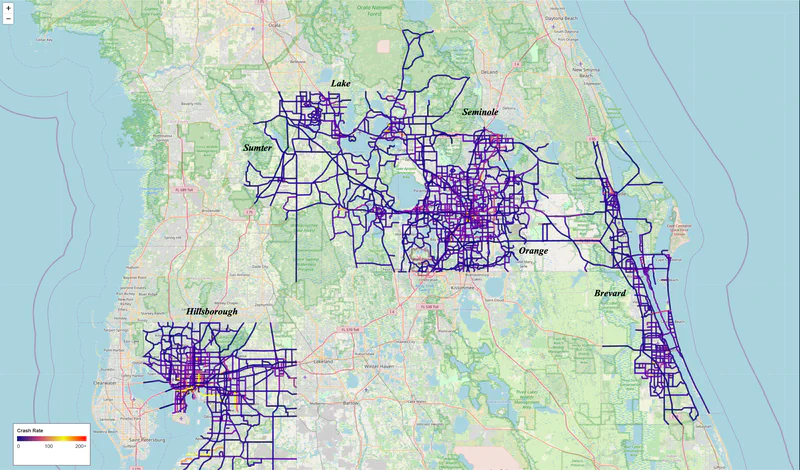
Connected-Vehicle Risk Prediction

Transforms CV trajectories, risky-driving events, and traffic states into real-time crash risk and crash type predictions.

Representative work: TR-C 2025 causal mediation framework with connected vehicle data; under-review BiLSTM-Transformer freeway crash risk model.

Causal graph and model explanation schematic
02

Causal and Explainable AI

Moves from prediction accuracy to mechanisms, counterfactuals, and policy-relevant explanation for roadway safety decisions.

Representative work: causal mediation, double machine learning, causal forests, and interpretable ML for crash risk, ADAS, and warning systems.

Spatial grid, temporal instability, and Bayesian heterogeneity schematic
03

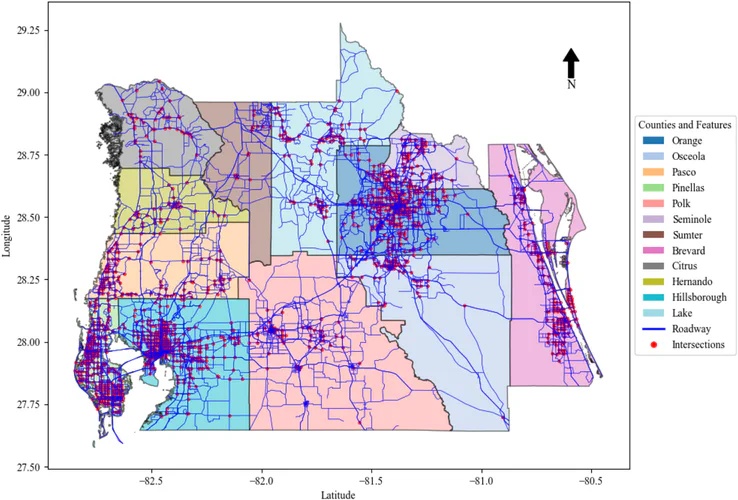
Spatiotemporal Heterogeneity

Models how crash risk and injury severity vary across time, space, intersections, counties, road users, and traffic contexts.

Representative work: AMAR 2025 grouped random-parameters Poisson-Lindley model with spatial effects.

Intersection conflict schematic for vulnerable road users
04

Vulnerable Road Users

Studies pedestrian, motorcycle, moped, and right-turn interaction risks using crash records, conflict data, field studies, and behavioral evidence.

Representative work: AMAR 2025 pedestrian injury severity across vehicle movements; AAP 2024 distracted pedestrian crossing safety.

ADAS and CAV cyber-safety schematic with connected vehicle platoon
05

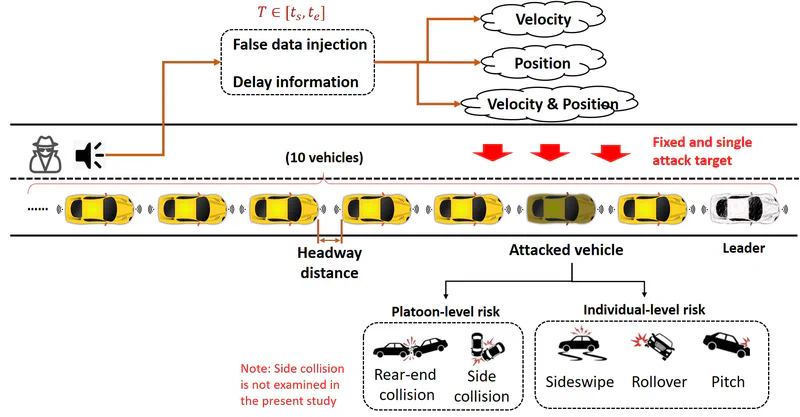
ADAS, CAV, and Cyber-Safety

Evaluates the real-world safety promise of ADAS/CAV systems, driver warnings, platoons, and cyberattack impacts in mixed traffic.

Representative work: ADAS effectiveness, in-vehicle warning personalization, and connected platoon cyberattack risk assessment.

Multimodal video event parsing and counterfactual safety schematic
06

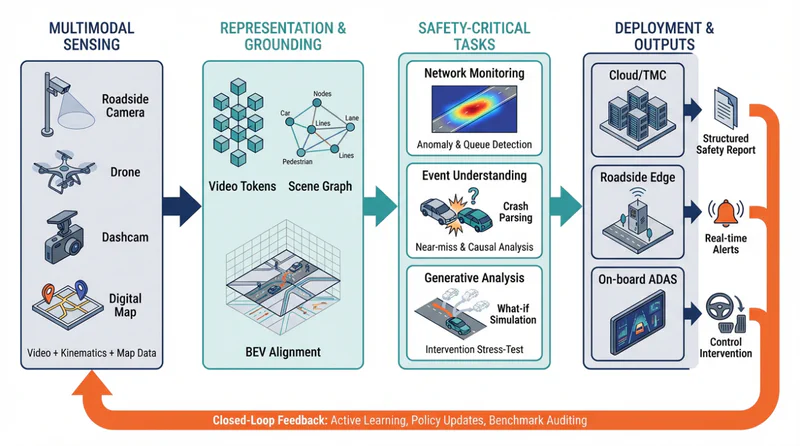
Multimodal Video and Generative Models

Builds toward first-person near-miss/crash datasets and LLM/VLM/diffusion workflows for interpretable traffic video safety analysis.

Representative work: SAVeD dataset under review; LLM-diffusion framework for ADAS crash event understanding in preparation.

Selected Publications by Topic

Connected Data, Prediction, and Explanation

  • From prediction to explanation: links machine learning crash-risk prediction with causal mediation to reveal mechanisms in connected-vehicle data. TR-C, 2025
  • Real-time freeway crash risk and type prediction: uses spatiotemporal sequence learning with connected vehicle data to anticipate both crash likelihood and crash type. Transportation Research Part C, under review.
  • LSTM + Transformer crash risk evaluation: combines traffic flow and risky-driving behavior data for real-time freeway risk assessment. IEEE T-ITS, 2024

Spatial, Temporal, and Bayesian Safety Modeling

  • Grouped random-parameters Poisson-Lindley with spatial effects: explains intersection crash frequency using visual environment features and macro/micro spatial effects. AMAR, 2025
  • Speed-difference injury severity: models correlated injury outcomes of leading and following vehicles under temporal instability. AMAR, 2024
  • Freeway rear-end and non-rear-end crashes: examines temporal stability and heterogeneity in crash injury severity. AMAR, 2022

Vulnerable Road Users and Human Behavior

  • Pedestrian injury severity across vehicle movements: jointly models left-turn, straight, and right-turn crash movements with spatial correlations. AMAR, 2025
  • Mobile phone distraction at street crossings: combines field evidence and behavioral analysis to understand pedestrian safety risk. AAP, 2024
  • Motorcycle and moped injury severity: studies helmet usage, temporal instability, and macro/micro disparities across rider injury outcomes. AAP / Transportmetrica A, 2024-2025.

Operations, ADAS, CAV, and Multimodal Safety

  • Tunnel crash severity and congestion duration: uses cross-stitch networks to jointly learn safety and mobility outcomes. AAP, 2025
  • ADAS safety effectiveness: assesses the real-world safety effects of advanced driver assistance systems. Journal of Safety Research, 2025
  • SAVeD: first-person social media dataset for ADAS-equipped near-miss and crash event analysis. Scientific Data, under review.
Collaboration

I am especially interested in collaborations on connected-vehicle analytics, crash-risk prediction, causal and Bayesian safety modeling, ADAS/CAV evaluation, vulnerable-road-user safety, and multimodal video understanding for near-miss and crash events.