I examine ADAS and connected and automated vehicle safety through crash-data analysis, simulation, and vehicle-dynamics-informed evaluation. Driving assistance and automated driving are distinct capabilities; safety claims must be tied to the technology and operating conditions being evaluated.
Safety-critical decision-making and recovery
Current collaborative research asks how vehicles can recover from developing hazards. The submitted ALARM study concerns local action safety boundaries and pre-crash safety recovery. A separate controller-state recovery study examines resilience during CAV-HDV on-ramp merging.
These are submitted research manuscripts, not claims of validated deployment performance.
Cyber-physical resilience and vehicle dynamics
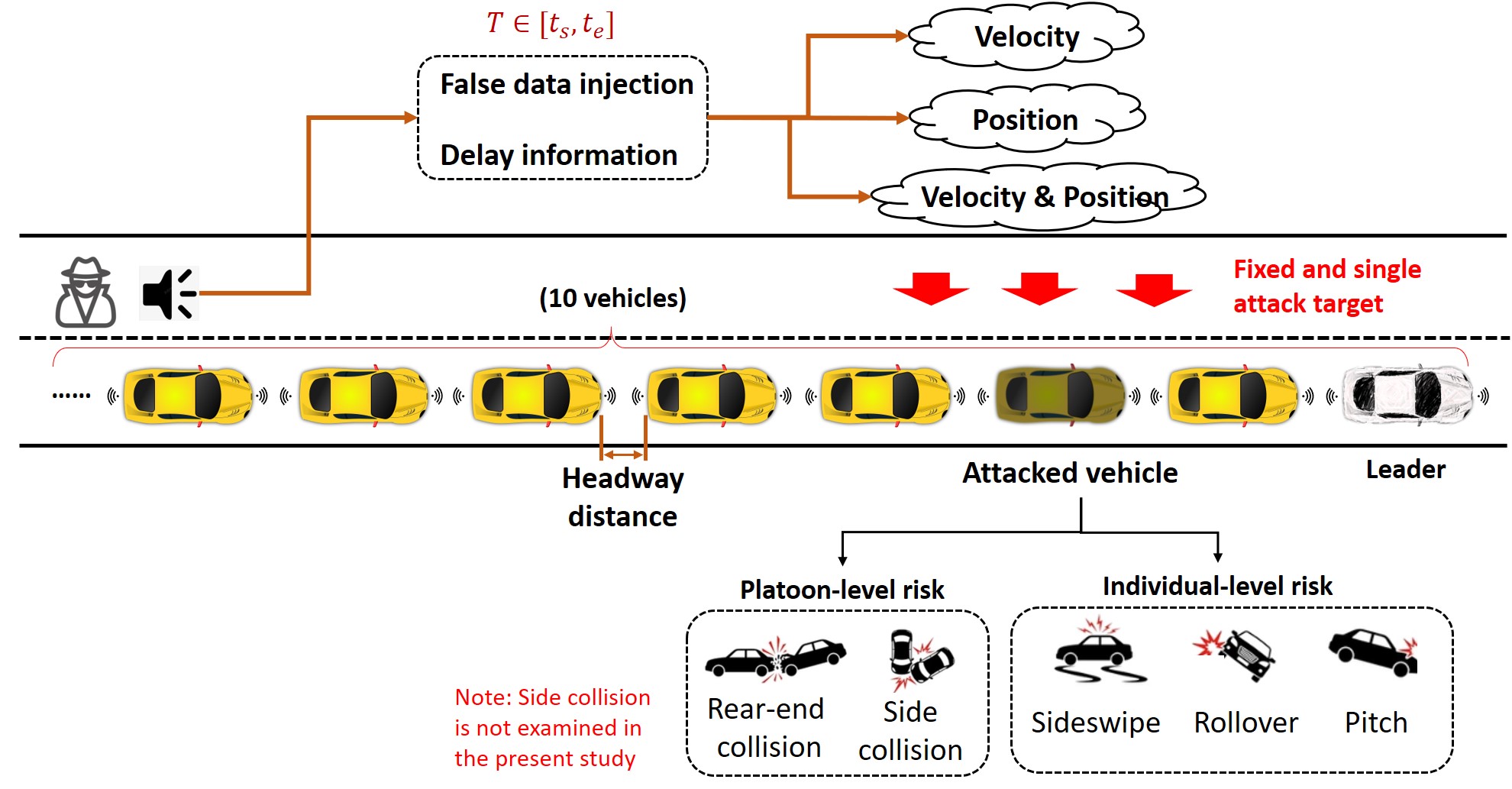
Communication failures and cyberattacks can affect vehicle behavior through physical constraints. The submitted tire-force risk-envelope study addresses CACC platoons under cyberattacks and reduced-friction roadways.
Related work includes a mixed-traffic cyberattack simulation platform and connected-platoon impact assessment. These studies connect information disturbances with vehicle dynamics and collision risk.
ADAS effectiveness and infrastructure compatibility
The published ADAS effectiveness study evaluates safety using real-world crash records.
As PI of an awarded FHWA project, I lead work on roadway design and infrastructure factors influencing ADAS technologies for mitigating rural roadway departure crashes. This complements the technology-focused work with a road-engineering perspective.
Methods: crash-data evaluation, simulation, causal analysis, vehicle-dynamics constraints, and safety-boundary assessment.